Can You Resin Print in an Apartment? Ventilation Setup Explained
Resin printing in an apartment is possible if you can vent outdoors. What the resin makers and NIOSH say, a window-vent setup, handling rules, and when to choose FDM instead.
DisclosureWe may earn a commission when you buy through links on this site, at no extra cost to you. As an Amazon Associate we earn from qualifying purchases.
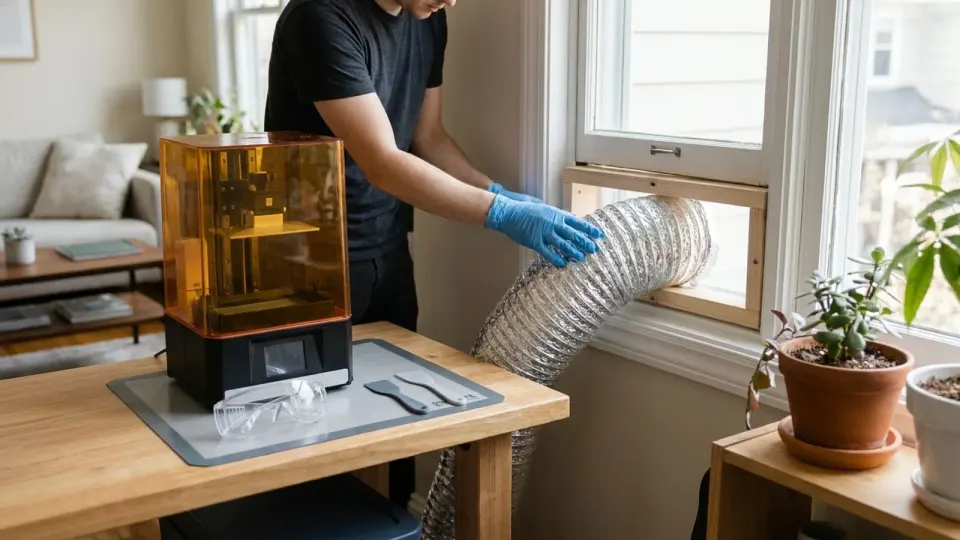
Yes, you can resin print in an apartment, if you can vent the printer’s air outdoors. The usual setup is the printer inside an enclosure, with an inline fan pulling air through a duct to a sealed window vent. Add nitrile gloves, eye protection and a sealed wash station. Resin makers’ safety data lists skin and eye irritation and allergic skin reactions, and printer manuals call for a well-ventilated area. “Low-odor” doesn’t mean the vapors are gone. If you can’t vent outdoors, an FDM printer is the safer choice.
Already decided? See our best resin printers for miniatures and the starter kit that goes with them.
What the makers and NIOSH actually say
- Resin is a skin and eye hazard. Elegoo’s product safety information for its photopolymer resin lists “Causes skin irritation”, “May cause an allergic skin reaction” and “Causes serious eye irritation”, and says to wear protective gloves, eye protection and face protection.
- Ventilation is part of the instructions. Elegoo’s Mars 5 Ultra manual says to operate the printer in a well-ventilated area to avoid inhaling resin fumes. Formlabs says to run its printers and wash stations where air circulates freely, so fumes and vapors don’t build up.
- Source control comes first. NIOSH’s guide Approaches to Safe 3D Printing (publication 2024-103) lists proper ventilation and HEPA filtration as engineering controls, and NIOSH publishes a separate infographic for desktop vat photopolymerization (resin) printing.
- Washing solvents add their own risk. Formlabs notes that isopropyl alcohol (IPA) is flammable, with a flash point of 12 °C (53 °F), and should be stored sealed, away from ignition sources.
Can your apartment handle it? A quick check
| Question | If yes | If no |
|---|---|---|
| Is there a window you can fit a vent panel into, near where the printer will sit? | Good start: plan an enclosure + duct + fan | Consider FDM, or a room that has one |
| Can the printer live in a room you don’t sleep in? | Good | Don’t resin print in a bedroom |
| Can you keep resin and IPA out of reach of kids and pets? | Good | Choose FDM |
| Does your lease allow window vents and fans? | Good | Ask first |
| Is the room reasonably warm in winter? | Good | Resin can behave differently in the cold. A heated printer like the Elegoo Saturn 4 Ultra 16K helps print quality, not ventilation |
The window-vent setup, step by step
- Enclosure. Put the printer (and ideally the wash station) in an enclosure, a tent or cabinet with a duct port. That keeps vapor in one place so the fan can pull it out.
- Inline fan and duct. Connect a 4-inch duct from the enclosure’s port to an inline fan, then to the window. AC Infinity rates its CLOUDLINE S4 at 226 CFM and 26 dBA with a 10-speed controller. It’s sold for grow tents, which are set up the same way.
- Sealed window vent. Use a vent panel or a cut board with a duct flange so air can’t blow back in.
- Fan direction. The fan should pull air out of the enclosure, so the enclosure sits at slightly lower pressure and leaks inward, not into your room.
- Let parts dry under ventilation. Formlabs advises letting washed parts dry for at least 30 minutes with ventilation maintained while the solvent evaporates.
AC Infinity CLOUDLINE S4 Inline Duct Fan (4-inch)
A 4-inch inline duct fan with a 10-speed controller. Sold for grow tents, but commonly used to pull fumes from a laser or resin enclosure out through a window vent.
- Duct size
- 4 in
- Airflow
- 226 CFM
- Noise
- 26 dBA
What about air purifiers?
A purifier is a fallback, not a replacement for venting. NIOSH lists HEPA filtration among source controls, but HEPA targets particles. For vapors you need activated carbon, and carbon fills up over time. If you use one, choose a unit with a sealed connection to the enclosure, follow the maker’s filter schedule and check that the maker lists it for resin printing. We don’t recommend a specific resin purifier yet, because we haven’t found one whose maker publishes resin-specific filtration data.
Handling resin and IPA in a small space
- Gloves every time. Formlabs recommends nitrile or neoprene. Change them if they tear or get resin on them, and don’t touch door handles or your phone with resin gloves.
- Eye protection when pouring resin or handling the vat.
- Work on a tray or silicone mat with paper towels, so drips don’t reach floors or furniture.
- Sealed wash. A wash and cure station keeps IPA in a closed bucket. The Elegoo Mercury Plus V3.0 has a 7.5 L bucket and a cover that stops UV curing when lifted, per Elegoo.
- IPA storage. Small amounts, sealed, labeled, away from heaters and open flames (Formlabs).
- Waste. Don’t pour resin or used IPA down the drain. Elegoo’s resin safety information says resin is toxic to aquatic life and must be disposed of according to applicable regulations. Check your city’s hazardous waste rules.
- Skin contact. Elegoo’s first-aid line is to wash with plenty of soap and water, and to get medical advice if irritation or a rash occurs.
Elegoo Mercury Plus V3.0 Wash and Cure Station
A two-in-one wash and cure station with a 7.5 L sealed wash bucket, a turntable with 24 UV LEDs and a cover that stops curing when lifted.
- Wash bucket
- 7.5 L
- Max wash size
- 230 x 135 x 260 mm (basket mode), 214 x 135 x 180 mm (hanging the build plate)
- Curing light
- 24 x 405 nm UV LEDs on a 360° turntable
When you should choose FDM instead
Pick an FDM (filament) printer if:
- there’s no window you can vent through, or the only option is your bedroom,
- you share the space with young kids or pets and can’t lock resin away,
- you’re not comfortable wearing gloves and cleaning up every print.
FDM has its own fume questions, but PLA in an enclosed printer is a simpler start for most homes. See our best 3D printers for teens and kids (enclosed, PLA-focused picks) and PLA vs PETG for beginners.
If you go ahead
Pick a small printer first. It’s easier to enclose and ventilate. Our best resin printers for miniatures compares 7-inch-class starters and the wash stations that fit them. More ventilation and safety gear is in tools and upgrades.
FAQ
Is resin printing safe indoors? It can be done indoors with the precautions the makers describe: gloves, eye protection and a well-ventilated area. In practice that means venting outdoors. Resin makers list skin and eye irritation and allergic skin reactions as hazards, so treat it as a chemical process, not a desk toy.
Do I need a resin printer enclosure with exhaust? If you print indoors, it’s the setup that best fits the makers’ “well-ventilated area” instructions and NIOSH’s focus on source control: it captures vapor at the printer and sends it outside. An enclosure without an exhaust only traps air around the printer.
Can I just open a window? An open window helps general airflow, but it doesn’t capture vapor at the printer. A duct from an enclosure to the window does.
Is water-washable resin safer? It changes the washing step (water instead of IPA), but it’s still a resin with its own SDS. Read it. Washing water with resin in it still shouldn’t go down the drain.
Can I resin print in my bedroom? We don’t recommend it. Put the printer in a room you don’t sleep in, with a window you can vent through.
Sources
- Elegoo: Product Safety Information, photopolymer resin (elegoo.com/pages/product-safety-information)
- Elegoo: Mars 5 Ultra user manual, safety section
- Elegoo: Wash and Cure Station 3.0 product page (elegoo.com)
- Formlabs: Introduction to isopropyl alcohol (IPA), Safety with Formlabs SLA products, Using the Form Wash (formlabs.com, support.formlabs.com)
- NIOSH: Approaches to Safe 3D Printing: A Guide for Makerspace Users, Schools, Libraries, and Small Businesses (publication 2024-103); Safe Desktop Vat Photopolymerization 3-D Printing infographic (cdc.gov/niosh)
- AC Infinity: CLOUDLINE S4 product page (acinfinity.com)